A useful candle business name should match what you sell and the experience you want buyers to imagine. A gift-focused jar-candle shop needs a different signal from a sculptural candle studio or a home-fragrance range. Start with that distinction, then shortlist names that work on a small label and when spoken aloud.
The ideas below are creative starting points developed for this guide. They are not verified as unused, available to register or legally cleared. Use them to explore a direction before investing in packaging or a domain.
If your range may expand beyond candles, compare neighboring product and shop naming approaches craft shop name ideas and home bakery name ideas.
Five directions to start your shortlist
These five options represent different positioning choices. Compare the trade-offs rather than treating the first name as a universal winner.
| Name | Positioning it suggests | Trade-off to consider |
|---|---|---|
| Folded Evening | A quiet, design-led home-fragrance range. | The name needs a clear candle descriptor on the storefront. |
| Small Batch Lamplight | A process-led maker with an intimate feel. | Longer on a small jar; use “small batch” only if it reflects your production. |
| Parcel of Glow | A gifting business built around presentation. | The emphasis may feel less suitable if you later focus on trade supply. |
| Claylight Objects | Sculptural candles or a range centred on ceramic vessels. | The clay association should fit the actual products. |
| Lumivell | An invented brand word that leaves the range open. | Customers may need spelling help; test it aloud before committing. |
Candle business name ideas by selling style
Quiet, atmospheric and design-led
Choose an atmosphere rather than a single scent if the collection will change. These options leave room for different fragrances, but the shop header still needs to explain that you sell candles.
| Name | Creative direction |
|---|---|
| Window at Dusk | Soft evening imagery for a restrained visual identity. |
| Stillroom Notes | A fragrance-led range organised like a collection of compositions. |
| Velvet Sundown | A richer, more dramatic mood without naming one ingredient. |
| Amber Interlude | A pause-in-the-day concept; check whether “amber” narrows expectations too far. |
| Evening Margin | A literary-feeling direction with space for seasonal collections. |
Maker-led and workshop-inspired
Process words can explain the business quickly. They also create expectations, so avoid language suggesting handwork, local production or particular materials unless those details are accurate.
| Name | Creative direction |
|---|---|
| Second Shelf Candleworks | A workshop identity with an everyday, approachable tone. |
| Handspan Candle Studio | A tactile, maker-centred direction if the production story supports it. |
| Pour and Paper | A candle-and-packaging identity suited to careful presentation. |
| Benchside Wicks | A practical studio feel with the product category close to the surface. |
| Little Kiln Lights | A vessel-led direction for a genuinely relevant ceramic story. |
Gifts, occasions and thoughtful parcels
Gift-led names can work across birthdays, thank-you presents and housewarmings. A permanent business name does not need to contain every occasion; those can become collection names instead.
| Name | Creative direction |
|---|---|
| A Little Afterglow | A small-gift concept with an affectionate tone. |
| Ribbon Hour | A presentation-first direction that can extend beyond candles. |
| Kindly Lit | A brief, warm-sounding option to test in speech. |
| Postscript Candles | A message-and-gift concept with a direct category descriptor. |
| The Thankful Wick | An occasion-led direction; consider whether it feels too narrowly tied to gratitude. |
Nature-inspired and more abstract directions
Nature imagery can set a mood without claiming the wax is natural, organic, non-toxic or environmentally superior. Keep those product claims separate and substantiate any you actually make.
| Name | Creative direction |
|---|---|
| Cedar Almanac | A seasonal collection concept with a woodland cue. |
| Moss and Meridian | A contrast between a tactile nature word and a more abstract one. |
| Orchard at Five | A specific scene rather than a general promise about ingredients. |
| Reedlit | A constructed word to test for spelling and unintended associations. |
| Vellora Wickworks | An invented lead word with a clearer product cue beside it. |
If candles are only one part of a wider handmade range, compare craft shop name ideas. A name tied closely to wicks or wax may be less flexible for a future shop that mainly sells textiles or ceramics.
Separate your brand, product type and scent names
A candle label has several jobs. The business name identifies the maker, the product description explains what is for sale, and a scent or collection name distinguishes one item from another. Asking one phrase to do all three can produce an awkwardly long business name.
For a fictional example, use Folded Evening as the brand, scented candle as the product description and Rain on Stone as one scent name. A later diffuser could share the brand without pretending to be a candle. This example is a layout and naming exercise, not a cleared brand or a complete product label.
If your plan is to stay focused on a single craft, a direct descriptor can be useful. If home fragrance is the longer-term aim, try the name beside “candles,” “room fragrance” and “gift sets” before committing. Our Business & Brand Names collection offers other category-specific approaches.
Descriptive, evocative or invented?
Descriptive names explain a product or process quickly, but can sound similar to other sellers. Evocative names suggest a mood and often need a category descriptor. Invented words can leave more room for a brand story, but introduce spelling and pronunciation work.
That is an editorial comparison, not a ruling on trademark strength. In the United States, the USPTO distinguishes suggestive, arbitrary and fanciful marks from weaker descriptive or generic terms. A creative-sounding name can still conflict with an existing mark; its style alone does not establish that you can use or register it.
Test three finalists in real selling situations
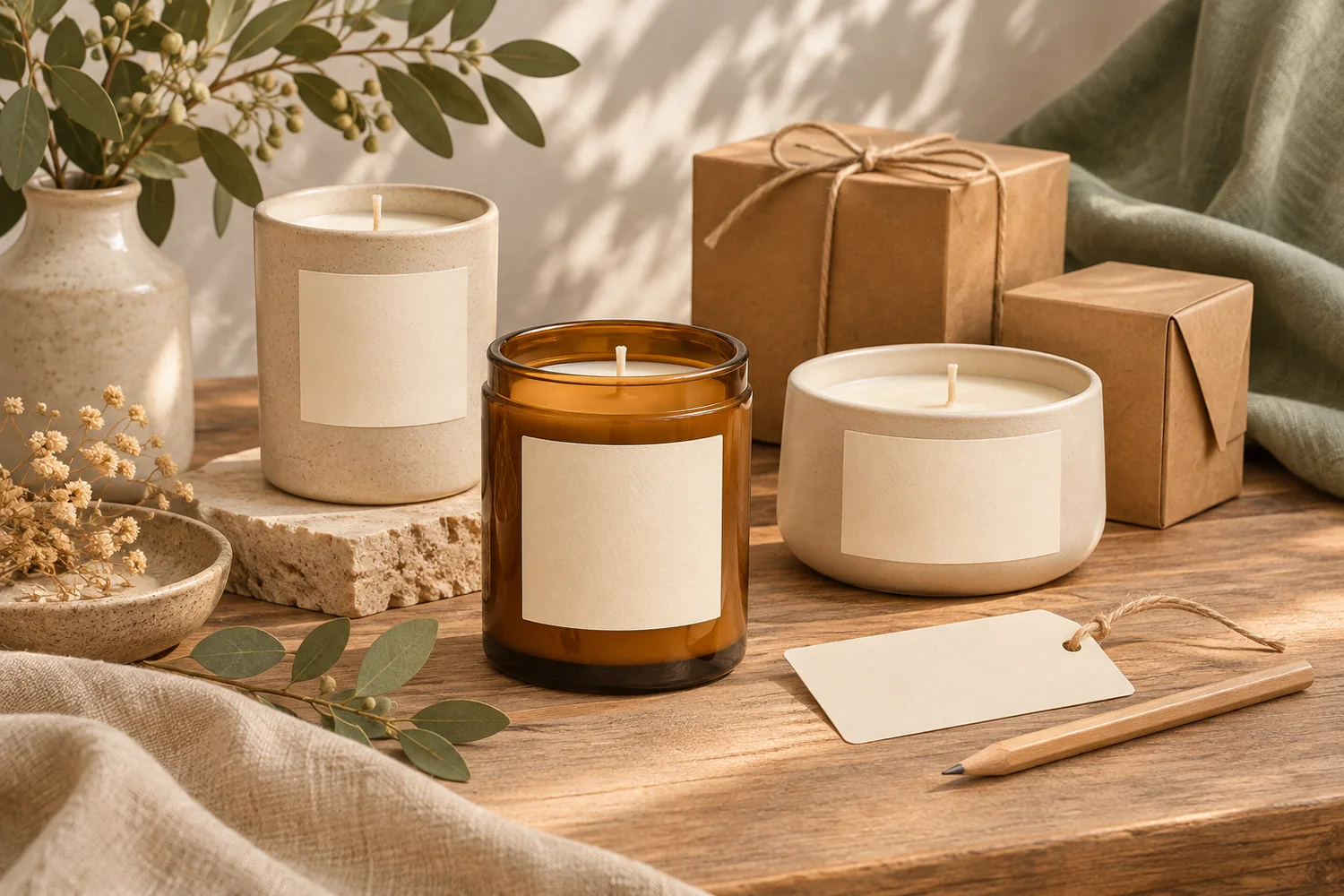
The label test: place each finalist at the same size on a simple jar-label mockup. Do not shrink one more than the others to make it fit. Compare Folded Evening with Small Batch Lamplight: the latter explains more, but takes more space. Keep the business name separate from required product information.
The spoken test: say “You can find us at Lumivell” to someone who has not seen the spelling. Ask them to write what they heard. If the answers vary, decide whether you are willing to repeat the spelling or whether a clearer option fits your sales channels better.
The range test: imagine your current candle beside a gift box and a future product. Parcel of Glow keeps the gift emphasis; Claylight Objects keeps the object or vessel emphasis. Choose the direction you intend to build, rather than whichever name produces the prettiest logo today.
Keep a short decision note for each finalist: intended buyer, product range, spelling friction, label fit and search findings. Do not invent a numerical score that hides a serious conflict behind good design marks.
Screen the shortlist before spending on it
Search exact and similar wording: look for the full name, close spellings and similar-sounding names in your target markets. Review related home-fragrance products as well as candles. Record what you found and when; a missing exact-match result is not clearance.
Check the relevant official systems: for a US business, the USPTO’s comprehensive clearance guidance describes searching federal records and other sources, including common-law use. Other countries have their own systems and requirements. A company-name registration, available handle or available domain does not resolve every trademark question.
Check practical availability separately: inspect the domain and the handles you actually need, but do not buy them merely because a generator offers them. If a finalist is important to a commercial launch, get qualified advice about the intended use and market before ordering branded stock. This guide supplies naming ideas, not legal clearance.
Common candle naming questions
Does the business name need the word “candle”?
No. It can sit in the storefront description and product labels instead. Including it makes the category clearer, while leaving it out can make a wider home-fragrance range easier to describe. Test both versions with your actual plan.
Should I put “soy” in the name?
Only consider it if that material is accurate and central to the range you intend to keep. A material-led business name can become awkward if you later change or broaden the products. It is not, by itself, evidence of a product’s safety or environmental impact.
Can I use one of these ideas immediately?
Treat every idea as an unvetted starting point. Check existing use, similar marks and your market’s requirements first. NamesCluster does not promise availability or exclusive ownership of any suggestion.
For more product-focused naming guides, visit Shops & Products.